

Adapted from Squirrly’s Expectation Marketing course. Updated November 10, 2026.
Expectation Marketing can improve how your team plans content and how buyers evaluate your brand. The benefits depend on useful content, dependable follow-through, and a clear path to contact or purchase. In this lesson, we’ll pair the short- and long-term benefits with the mistakes that can prevent them.
The Short-Term Outcome of Expectation Marketing
One of the first things you may improve, even before publishing a new article, is your team’s productivity.
A shared workflow makes it easier for the team to see what needs to be created, reviewed, and published next. The benefit comes from organizing the work, not simply adding more output targets.
At Squirrly we saw this for the first time in 2015. Everybody on our marketing team had a clear idea of what they had to do. If they felt they finished all their tasks, they knew of the upcoming articles that needed to be written.
It was obvious what we promoted and where. It was also easy to divide the work and make sure we had a constant flow of content published on our site.
Now the biggest mistake you can make at this point, and we’ve seen this in some other startup marketing teams is to apply only half of the strategy. What this means is that they saw that posting consistently helped their site and brand.
So they added to their team’s KPIs all that would show they had a good Expectation Marketing Strategy:
- Publish useful articles on a schedule the team can sustain.
- Adapt social posts to each platform and the audience’s interests.
- Keep the channels you actively promote accurate and maintained.
- Respond on the channels you actively maintain
- Balance educational content, relevant outside sources, and offers according to audience response, rather than a fixed percentage.
But they hadn’t implemented a way to manage and keep track of it properly. Added to the fact that this wasn’t the only KPIs the team had, it made them more disorganized than before.
They were trying to make everything happen at the same time. The teams also didn’t take a chance to organize and create the content in advance correctly.
They were barely creating enough content to meet each week’s quota. To avoid that trap, connect topic selection, writing, review, scheduling, and distribution in one shared workflow.
Build a content buffer where possible. Planning the next month’s themes in advance can help, while leaving room for timely questions and updates.
Another potential benefit is that visitors can see evidence of an active brand. There is no universal timetable: it depends on who sees the content, how useful it is, and whether the rest of the customer experience supports the message.
This aspect is important in the digital marketing world, but it is also hard to track. Some benefits you might start seeing are:
- Reactions to your Social Media posts
- Shares to your articles
- A steady increase in followers on Social Media
- New subscribers to your email lists
- Comments on your articles
- Emails and phone calls that reference the topic or the articles you’ve published.
You might only see some of them, and as it can manifest in different ways, you might not be able to recognize it as the advantages of strategy.
The original Philipp Kandal case used article comments as one sign of reader interest. It is a historical example, not a current performance measure.

First, it confirms that there is an audience that reads and enjoys the content.
Second, that they are interested in the brand and they want to interact with it.
Third, that they will find a way to come back to that content. It can happen in different ways. It can be a notification they get that the conversation has gone further, or they bookmark the article for a second read, or they might even pin your article to a Pinterest board.
Now the most common mistake teams make in this expectation marketing aspect is that they aren’t consistent. Especially across their channels. It’s great that you have an active blog, but that isn’t everything.
If an article leads readers to a promoted social profile with outdated offers or unanswered questions, that mismatch can undermine confidence.
A visitor may check your website and a preferred social channel. Keep the story and the next step consistent wherever you direct them.
An older profile is not proof that a business is inactive. Keep its description and contact details accurate, and explain where customers can now find updates.
To avoid this mistake yourself research different articles you can share from your profiles. If you don’t know where to start with this step, let us know.
The Long-Term Results for Your Business
Over time, a useful content library and reliable communication can give people reasons to return. Look for signals such as:
- Repeat visitors on site
- Growing followers on Social Media
- A real email list with a lot of subscribers
- Engaging discussions with your audience.
But economically this does not help your brand. You need some transaction from them to happen.
Now if you’re a company that’s simple you need them to buy your products or services. If you’re an NGO, you need them to donate to your cause. And if you are a speaker you will need people to invite you to their events.
The main advantage you’ll have with this strategy is that you can easily remind your audience what you can offer them. And you can do this through the channel that they choose or use the most.
Think about it; the reader chose for a good reason to subscribe to your newsletter or follow your profile. So you are in the environment where they consume content. You just need to use that to your advantage.
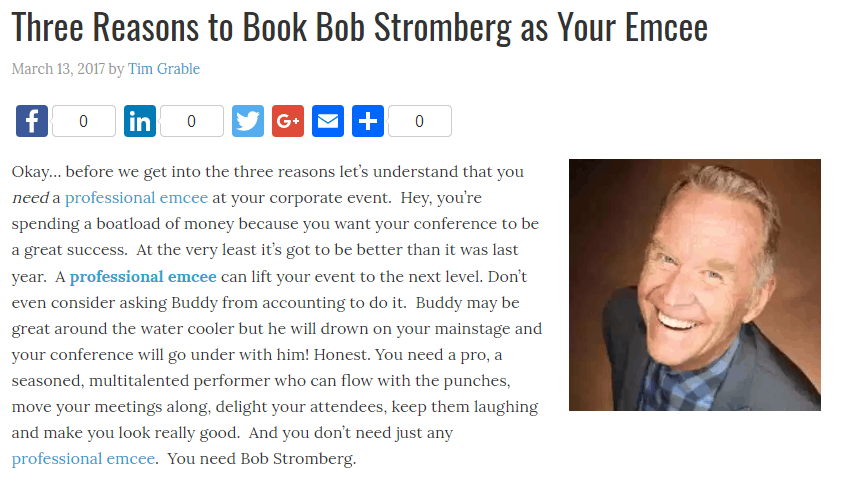
One great example comes from one of our clients, The Grable Group. They make sure to remind their audience of event planners the benefits their entertainers can bring to their event, as you can see in this article about Bob Stromberg.
The big mistake many companies make especially in their email strategy is to focus only on what you have to tell them. Just because you have the option to remind them of your product, doesn’t mean you should do it too often.
In the end, they want to see great content that helps them, not just your brand finding another way to promote aggressively.
Keep in mind that as people choose to listen to you, they can also choose to not listen to you anymore.
The most fulfilling advantage, I believe is that your audience will contact and offer you information without you asking them. When you have this you know you’ve done your marketing strategy well.
You can find Support emails that refer to complex problems, and people will reference you articles where they’ve already learned it.
They might send you feedback as we receive many times on email. Or they might just be sending you a personal email with questions.
In the original lesson, Squirrly used feedback around its historical “Steve” SEO release to illustrate why launch questions and beta-user input should feed back into content and product work.
Take note that in the examples I gave above I did not refer to social media reactions or comments on blogs. Those are the first and the easiest way for your audience to interact with you. Contacting you via email or phone means that they put extra effort in doing it.
This aspect is also connected to the last mistake I will present today. Meaning not reacting back to your audience’s interactions. If you’d like to get the long-term advantages of Expectation Marketing, then you need to make sure that you read and respond to comments on social media.
People need to see this to take the time to contact you further through email or phone.
If people write to you on X (formerly Twitter) and you never answer, what lets them know you’ll ever answer on email? What gives them the confidence to do business with you?
Some companies even lose sales due to mistakes like these.
Your Expectation Marketing Journey
Now you know all the aspects of the strategy, and you are ready to start applying it. Make sure that you don’t make the mistakes I’ve mentioned here :
- Apply the whole strategy not just bits and pieces
- Maintain the channels you actively promote with a realistic schedule and response process
- Don’t overdo it with promoting your products
- Answer your comments and the reactions you get on social media, or your audience will leave.
Continue with the bonus lesson to learn how to collect audience questions and turn them into useful content topics.
Continue the Expectation Marketing course
- Lesson 1: How Your Marketing Strategy Can Really Work
- Lesson 2: Why Is Expectation Marketing Important For Your Business
- Lesson 3: How to Audit Your Site to See If You’re Doing Expectation Marketing Right
- Lesson 4: Getting Better at Expectation Marketing, an Actionable Plan
- Lesson 5: The Benefits and Mistakes of Applying Expectation Marketing
- Bonus Lesson: How to Meet Customer Expectations with Amazing Content
Original lesson: Lesson 5: The Benefits and Mistakes of Applying Expectation Marketing.